The nine most important things Shane Oliver has learnt about investing over the past 35 years

I have been working in and around investment markets for 35 years now. A lot has happened over that time. The 1987 crash, the recession Australia had to have, the Asian crisis, the tech boom/tech wreck, the mining boom, the Global Financial Crisis, the Eurozone crisis. Financial deregulation, financial reregulation. The end of the cold war, US domination, the rise of Asia and then China. And so on. But as someone once observed the more things change the more they stay the same. And this is particularly true in relation to investing. So, what I have done here is put some thought into the nine most important things I have learned over the past 35 years.

# 1 There is always a cycle

Droll as it sounds, the one big thing I have seen over and over in the past 35 years is that investment markets constantly go through cyclical phases of good times and bad. Some are short term, such as those that relate to the 3 to 5 year business cycle. Some are longer, such as the secular swings seen over 10 to 20 year periods in shares. Some get stuck in certain phases for long periods. Debate is endless about what drives cycles, but they continue. But all eventually contain the seeds of their own reversal. Ultimately there is no such thing as new eras, new paradigms and new normal as all things must pass. What’s more share markets often lead economic cycles, so economic data is often of no use in timing turning points in shares.

# 2 The crowd gets it wrong at extremes

What’s more is that these cycles in markets get magnified by bouts of investor irrationality that take them well away from fundamentally justified levels. This is rooted in investor psychology and flows from a range of behavioural biases investors suffer from. These include the tendency to project the current state of the world into the future, the tendency to look for evidence that confirms your views, overconfidence and a lower tolerance for losses than gains. So, while fundamentals may be at the core of cyclical swings in markets, they are often magnified by investor psychology if enough people suffer from the same irrational biases at the same time. From this it follows that what the investor crowd is doing is often not good for you to do too. We often feel safest when investing in an asset when neighbours and friends are doing the same and media commentary is reinforcing the message that it’s the right thing to do. This “safety in numbers” approach is often doomed to failure. Whether its investors piling into Japanese shares at the end of the 1980s, Asian shares into the mid 1990s, IT stocks in the late 1990s, US housing and dodgy credit in the mid 2000s or Bitcoin in 2017. The problem is that when everyone is bullish and has bought into an asset in euphoria there is no one left to buy but lots of people who can sell on bad news. So, the point of maximum opportunity is when the crowd is pessimistic, and the point of maximum risk is when the crowd is euphoric.

# 3 What you pay for an investment matters a lot

The cheaper you buy an asset the higher its prospective return. Guides to this are price to earnings ratios for share markets (the lower the better – see the next chart) and yields, ie the ratio of dividends, rents or interest payments to the value of the asset (the higher the better). Flowing from this it follows that yesterdays winners are often tomorrows losers – because they became overvalued and over loved and vice versa. But while this seems obvious, the reality is that many find it easier to buy after shares have had a strong run because confidence is high and sell when they have had a big fall because confidence is low. But the key point is that the more you pay for an asset the lower its potential return and vice versa.


Source: Global Financial Data, AMP Capital

# 4 Getting markets right is not as easy as you think

In hindsight it all looks easy. Looking back, it always looks obvious that a particular boom would go bust when it did. But that’s just Harry hindsight talking! Looking forward no-one has a perfect crystal ball. As JK Galbraith observed “there are two kinds of forecasters: those who don’t know, and those who don’t know they don’t know.” Usually the grander the forecast – calls for “great booms” or “great crashes ahead” – the greater the need for scepticism as such calls invariably get the timing wrong (in which case you lose before it comes right) or are dead wrong. Market prognosticators suffer from the same psychological biases as everyone else. If getting markets right were easy, then the prognosticators would be mega rich and would have stopped doing it long ago. Related to this many get it wrong by letting blind faith – “there is too much debt”, “house prices are too high and are guaranteed to crash”, “the Eurozone will break up” – get in the way of good investment decisions. They may be right one day, but an investor can lose a lot of money in the interim. The problem for ordinary investors is that it’s not getting easier as the world is getting noisier as the flow of information and opinion has turned from a trickle to a flood and the prognosticators have had to get shriller to get heard.

# 5 Investment markets don’t learn

A key lesson from the history of investment markets is that they don’t seem to learn. The same mistakes are repeated over and over as markets lurch from one extreme to another. This is even though after each bust many say it will never happen again and the regulators move in to try and make sure it doesn’t. But it does! Often just somewhere else. Sure, the details change but the pattern doesn’t. As Mark Twain is said to have said: “history doesn’t repeat, but it rhymes.” Sure, individuals learn and the bigger the blow up the longer the learning lasts. But there’s always a fresh stream of newcomers to markets and in time collective memory dims.

# 6 Compound interest is like magic

This one goes way back to my good friend Dr Don Stammer. One dollar invested in Australian cash in 1900 would today be worth $240 and if it had been invested in bonds it would be worth $950, but if it was allocated to Australian shares it would be worth $593,169. Although the average annual return on Australian shares (11.8% pa) is just double that on Australian bonds (5.9% pa) over the last 119 years, the magic of compounding higher returns leads to a substantially higher balance over long periods. Yes, there were lots of rough periods along the way for shares as highlighted by arrows on the chart, but the impact of compounding at a higher long-term return is huge over long periods of time. The same applies to other growth-related assets such as property.


Source: Global Financial Data, AMP Capital

# 7 It pays to be optimistic

The well-known advocate of value investing Benjamin Graham observed that “To be an investor you must be a believer in a better tomorrow.” If you don’t believe the bank will look after your deposits, that most borrowers will pay their debts, that most companies will grow their profits, that properties will earn rents, etc then you should not invest. Since 1900 the Australian share market has had a positive return in roughly eight years out of ten and for the US share market it’s roughly seven years out of 10. So getting too hung up worrying about the next two or three years in 10 that the market will fall risks missing out on the seven or eight years out of 10 when it rises.

# 8 Keep it simple stupid

Investing should be simple, but we have a knack for overcomplicating it. And it’s getting worse with more options, more information, more apps and platforms, more opportunities for gearing and more rules & regulations around investing. But when we overcomplicate investments we can’t see the wood for the trees. You spend too much time on second order issues like this share versus that share or this fund manager versus that fund manager, so you end up ignoring the key driver of your portfolio’s performance – which is its high-level asset allocation across shares, bonds, property, etc. Or you have investments you don’t understand or get too highly geared. So, it’s best to keep it simple, don’t fret the small stuff, keep the gearing manageable and don’t invest in products you don’t understand.

# 9 You need to know yourself to succeed at investing 

We all suffer from the psychological weaknesses referred to earlier. But smart investors are aware of them and seek to manage them. One way to do this is to take a long-term approach to investing. But this is also about knowing what you want to do. If you want to take a day to day role in managing your investments then regular trading and/or a self managed super fund (SMSF) may work, but you need to recognise that will require a lot of effort to get right and will need a rigorous process. If you don’t have the time and would rather do other things like sailing, working at your day job, or having fun with the kids then it may be best to use managed funds. It’s also about knowing how you would react if your investment suddenly dropped 20% in value. If your reaction were to be to want to get out then you will either have to find a way to avoid that as you would just be selling low and locking in a loss or if you can’t then you may have to consider an investment strategy offering greater stability over time (which would probably mean accepting lower returns).

So what does all this mean for investors?

All of this underpins what I call the Nine Keys to Successful Investing which are:

  1. Make the most of the power of compound interest. This is one of the best ways to build wealth and this means making sure you have the right asset mix. 
  2. Don’t get thrown off by the cycle. The trouble is that cycles can throw investors out of a well thought out investment strategy. But they also create opportunities. 
  3. Invest for the long term. Given the difficulty in getting market and stock moves right in the short-term, for most it’s best to get a long-term plan that suits your level of wealth, age, tolerance of volatility, etc, and stick to it. 
  4. Diversify. Don’t put all your eggs in one basket. But also, don’t over diversify as this will just complicate for no benefit.
  5. Turn down the noise. After having worked out a strategy thats right for you, it’s important to turn down the noise on the information flow and prognosticating babble now surrounding investment markets and stay focussed. In the digital world we now live in this is getting harder.
  6. Buy low, sell high. The cheaper you buy an asset, the higher its prospective return will likely be and vice versa. 
  7. Beware the crowd at extremes.Don’t get sucked into the euphoria or doom and gloom around an asset.
  8. Focus on investments that you understand and that offer sustainable cash flow. If it looks dodgy, hard to understand or has to be based on odd valuation measures or lots of debt to stack up then it’s best to stay away. 

Seek advice. Given the psychological traps we are all susceptible too and the fact that investing is not easy, a good approach is to seek advice

Written by Shane Oliver of AMP Capital

Protecting your Super – What does it all mean?

What is it?

The Protecting Your Super Package which passed in February 2019 has seen a range of measures recently introduced which affect the way that small and inactive superannuation accounts are handled.  In the main, these measures are a positive.  The key objective of the legislation is to limit the erosion of low balance super accounts by fees and unwanted insurance premiums.

For most of you, APC will have worked together with you to ensure your superannuation accounts are consolidated or in good working order.  But for various reasons, individuals might have a number of superannuation accounts at any given point in time – so sometimes it can be hard for you to keep track.   Given the pace of implementation of some of these changes, we have provided an overview of the key measures below – and always, APC is here to help.

Insurance Opt-In

The first stage of these measures has begun to take place. Certain people will have been asked to ‘opt-in’ for their insurance before 1 July 2019 – that is, an election made to keep your insurance despite having an inactive account.  Opting-in notifies your super fund that you are aware of the insurance and that you do want to continue paying the premium.  If you have done this, you won’t need to do it again.  It only becomes a question once an account becomes inactive and this generally means 16 months without activity, like any contributions received.

Inactive Low Balance Accounts

Super funds will be required to transfer ‘inactive low balance’ accounts to the Australian Tax Office if certain criteria is met, commencing in the coming months and then ongoing.  Low balance means less than $6,000.  The account must also be deemed inactive for the preceding 16 months.  If you have insurance that you ‘opted-in’ for attached to the account, you won’t be affected.

Once transferred, the ATO will aim to locate your ‘active’ account, ultimately consolidating your superannuation monies there.

What should you do?

Consolidation of your inactive accounts is likely to be a good thing for most, particularly if you might have accounts from previous employment that you have had trouble keeping track of.

If you think an unwanted change has been made to your accounts, please feel free to contact us or raise it at your next planning meeting.  This includes any cancellation of insurance cover that might have formed part of your wealth protection strategy.

Using MyGov to keep Track

A great place to start will be through your myGov account.  Specifically, ‘linking’ the ATO will allow you to see the information they have about your superannuation balances and accounts.

In fact, APC might ask you for information from time to time which can be found here and that will allow us to better advise you when it comes to your superannuation strategies.  This will be an important tool and ‘source of truth’ for most going forward.

As always, if you have any questions please don’t hesitate to ask.

Understanding the Real Income Return on Property Investment

Investing in Australian residential property is an aspiration for many.  APC recognises the diversification benefit of owning an investment property in your financial asset portfolio. As it is unlisted, this asset class behaves differently to listed assets such as shares.  This is what is called ‘correlation benefit’ meaning that as assets move in value (up or down) they do so at different times resulting in a smoother rate of return over time.

However it is our experience that investors do not always take into account the risks associated with owning residential investment property.  Some of these include;

  • Illiquidity risk
  • Single asset risk
  • High transaction costs to both purchase and sell
  • High carrying costs

Over many years of assessing the rate of return of investment property, it is our experience that the actual return on investment (ROI) is often far lower than many owners actually believe it to be.

This article deals with understanding what the actual expenses are in owning an investment property so that you can accurately assess (hopefully before purchasing an investment property) what the likely ROI – return on investment – will be.  By doing so, you can compare that ROI with other potential investment assets to ultimately determine the best investment decisions for you.

Quoted Income ROI Figures – Gross or Net?
Generally speaking, an investor in Australian residential property has – or should have – a long term investment time horizon.   

We often see rental income ROI figures quoted by agents that on the face of it look quite attractive. However when you scratch beneath the surface all is not as it seems.  The following example illustrates some of the costs you should be well aware of;

Melbourne apartment – $600,000 with an income yield of 3.75%


However, the quoted purchase price does not include costs associated with the purchase itself such as stamp duty, agent and conveyancing costs.


So the actual purchase price is $634,070 and therefore the rental yield is 3.55%.


However, this also is not the full story as to produce the ongoing rental income, there are likely other expenses that are incurred.  These include agency fees, rates, body corporate fees, insurance and a provision for maintenance or a sinking fund.  The sinking fund is to cover the costs of ‘plant & equipment’ that over time will fail and need to be replaced.  This does not include the sinking fund for ‘Capital Works’ that a body corporate may also have if the investment property is an apartment.


So, what started as an income ROI of 3.75% has now become 1.53%!

For some investors, another cost which is not included in this example is land tax. In Victoria, land tax is payable on taxable land you own over the value of $250,000. The rate of tax increases as the value of taxable land you own increases. Your home is not included as a taxable land value.

If you owe land tax then this cost also should be included in the ongoing costs of owning a residential investment property.

Depreciation
An important tax deduction available for residential property investors is depreciation.  This deduction improves the after tax return of a property asset. From July 1st, 2017 there were important changes to what depreciation on ‘plant & equipment’ such as dishwashers, carpets, hot water systems etc can be claimed. 

Essentially, if you purchased an investment property after May 20th, 2017 and the ‘plant & equipment’ in that property had already been ‘used’ at that date, you cannot claim any depreciation deduction on that asset. If however you then purchase a new asset (say a dishwasher) then a depreciation expense can be claimed.

So, if you are considering purchasing a residential investment property only ‘new’ plant & equipment may be depreciated and that value used as a tax deduction.

Travel Expenses
Also May 20th, 2017, you cannot claim any travel expenses related to that residential investment property.

Conclusion
Ultimately, the ‘after tax’ income ROI on an investment property will include other factors such as;

  • The owner’s marginal rate of income tax
  • The amount borrowed to purchase the asset
  • The interest rate on the loan
  • The legitimate depreciation claimed
  • Prevailing rate of inflation over the measure time period

Just ensure that you are incorporating all the associated costs of the property to ensure that you understand what the accurate income ROI actually is. Once you know this you can then more easily understand what the ‘break even’ rate of capital return needs to be.

With these two important pieces of analysis you are in a position to know if you should (a) hold an existing property asset or (b) purchase one.

As always, if you wish discuss this article with APC please contact any member of our advice team.

APC Investment Returns – Let’s Look Deeper

In reviewing the performance figures for the APC Classic Portfolios (click here) you will notice that for the first time in quite some time, some portfolios have underperformed their benchmark over the 1 Year time frame though they all outperform over longer timeframes.

One year returns can vary significantly due to short term factors, so this timeframe is really just ‘noise’ when it comes to understanding an investment portfolio’s long term capacity.  However it is important to understand why this has occurred. We explore this below and the reasons behind the variance from the ‘benchmark’.

A Quick Review: ‘Our Investment Philosophy’
As you may recall, Australian Private Capital (APC) has an Investment Philosophy that is evidenced based on many years of academic research with the following as keystone principles, when it comes to the equity component:

  • Risk and Return are related – the greater the Risk, the greater the expected Return
  • Small Cap stocks have a greater expected Return than Large Cap stocks given they have inherently greater associated Risk – (Size Premium)
  • Value (or cheap) stocks have a greater expected Return than Growth stocks- (Value Premium)

Hi

The ‘Size Premium’ is reasonably easy to understand.  All large companies were once small companies.  As an investor, if you buy a stock in a small company and due to it’s success it becomes a large company, you will do very well.  The risk of course is that not all small companies become large and some will fail.  This is the associated risk of investing in small cap stocks.  APC diversifies this risk by buying many ‘small cap’ stocks in our portfolios.   

The ‘Value Premium’ is also reasonably easy to understand.  An accountant values a company which is known as the ‘Book Value’.  The sharemarket will value the same company (it’s share price) and by multiplying the number of shares on issue by the share price this generates a ‘Market Value’.  Those companies that have a ‘Market Value’ less than the ‘Book Value’ are considered undervalued or ‘cheap’ and this is known as the ‘Value Premium’.  The reasons for this undervaluation can be varied however over time many of these of companies generate a greater return for investors given the greater associated risk of investing in ‘under-valued’ companies.  APC diversifies this risk by buying many ‘value’ stocks in our portfolios.

What is the Evidence?
As APC’s Investment Principles are based on a ‘rules based’ approach, it is possible to track how often the ‘Size Premium’ and the ‘Value Premium’ are evident over various time periods historically:


Based on this research APC’s portfolio ‘tilts’ towards ‘Small Cap’ stocks and ‘Value’ stocks will likely generate a greater Return than the broader market for the majority of the time, which historically has been the case.

So What Happened During the Last 12 Months?
However sometimes this is not the case and over the past 12 months both ‘Small Cap’ stocks and ‘Value’ stocks have underperformed ‘Large Cap’ and ‘Growth’ stocks both here in Australia and  overseas:


As illustrated above, both of the ‘tilts’ that APC adopt in the Australian and international shares sectors underperformed the broader market over the past year leading to the growth oriented APC Classic Portfolios underperforming their benchmarks for the first time in many years.

In Summary
Whilst these specific ‘tilts’ in APC’s Investment Philosophy are likely to generate greater portfolio returns over medium to longer timeframes, it is not always the case over shorter timeframes and in the 12 months to June this year we have experienced an absence of both the premiums we expect to observe. 

We understand this happens from time to time and have observed it before.

Past investment behaviour informs us that ‘Small cap’ and ‘Value’ stocks will likely return to generating an investment return premium but we just don’t know when. However when they do history illustrates their outperformance is likely to be significant and reward the patient investor.

As always, if you would like to discuss your portfolio with APC we would encourage you to contact any member of the advice team who will be happy to assist.

APC’s 30th anniversary

In March APC celebrated 30 years of holding our own Australian Financial Services License or AFSL.  This was quite a significant milestone as very few advisory firms would have remained privately owned and self-licensed for that length of time.  Most would have been acquired by larger firms as for many getting bigger is synonymous with being better.  However this is rarely true from the client’s perspective and is not aligned with APC’s ‘Client First’ approach.

This anniversary provides testament to APC’s enduring philosophy of being boutique and developing personal relationships both with our clients as well as our team.  By providing valued advice to our clients and professional opportunities for our team, APC strives to have long term relationships with both.  It is aligned with our goal to ensure that over time, as APC’s shareholding may change, APC as a privately owned, self-licensed advisory firm, will remain.

What did we do?
To mark the occasion APC took our team to Adelaide on Friday March 29 to enjoy a private wine tour of some wineries in the Barossa Valley.


Whilst Penfolds is of course perhaps the most well-known winery, we were impressed by the first winery we went to which was Seppeltsfield. Started by Joseph and Johanna Seppelt just 15 years after European settlement in South Australia, Seppeltsfield has the longest unbroken lineage of Tawny (from 1878 to present day) in the world.

It was not lost on us, given why we were in Adelaide and what we were celebrating, the significance of such a collection and the singular purpose and vision of the Seppelt family to create such a legacy.  Further, after a ‘relatively’ brief experience of being owned by a corporation (1985-2007), it returned to being privately owned which it remains to this day, under the stewardship of Warren Randall who worked for B Seppelt & Sons in the 1980s.  Warren believes that under private ownership, the estate can best endure as the custodian of the Seppelt family legacy.  For APC, its owners and team, this resonated quite profoundly.

After an enjoyable day in the Barossa, we returned to the Intercontinental Hotel for an hour or two of rest before reconvening for a team dinner in the hotel’s Shiki Japanese restaurant.  It was a lively and thoroughly enjoyable evening where we shared many APC stories and toasted the founder of APC, Michael Tratt and our inaugural Practice Manager, Marie Tratt.


That night partners arrived from Melbourne and the remainder of the weekend was our team’s to enjoy.  However it was lovely to see many catch up over the weekend with some visiting the Haigh’s chocolate factory, while others the Japanese gardens.  A few played golf at Royal Adelaide and Kooyonga.  Others went back for a second look at the Barossa!

Thank you!

Of course, we are able to celebrate 30 years of APC because of our enduring relationships with our clients.  We regard the opportunity to be of service as a privilege and one that all members of APC, both past and present, genuinely value and enjoy.

Here’s to the next 30 years!

All our best,

The APC Team.


Uncommonly Average

Jim Parker, Vice President, Dimesional Fund Advisors – May 2019

Ask a farmer about average rainfall figures and he’s likely to look at you sceptically. Knowing how actual rainfall varies from year to year, farmers will carefully manage their crops and irrigation. It’s a lesson many investors could learn as well. Staying disciplined when markets are volatile is easier once you accept that references to “average” annual returns, like rainfall, can mask a wide range of possible outcomes.

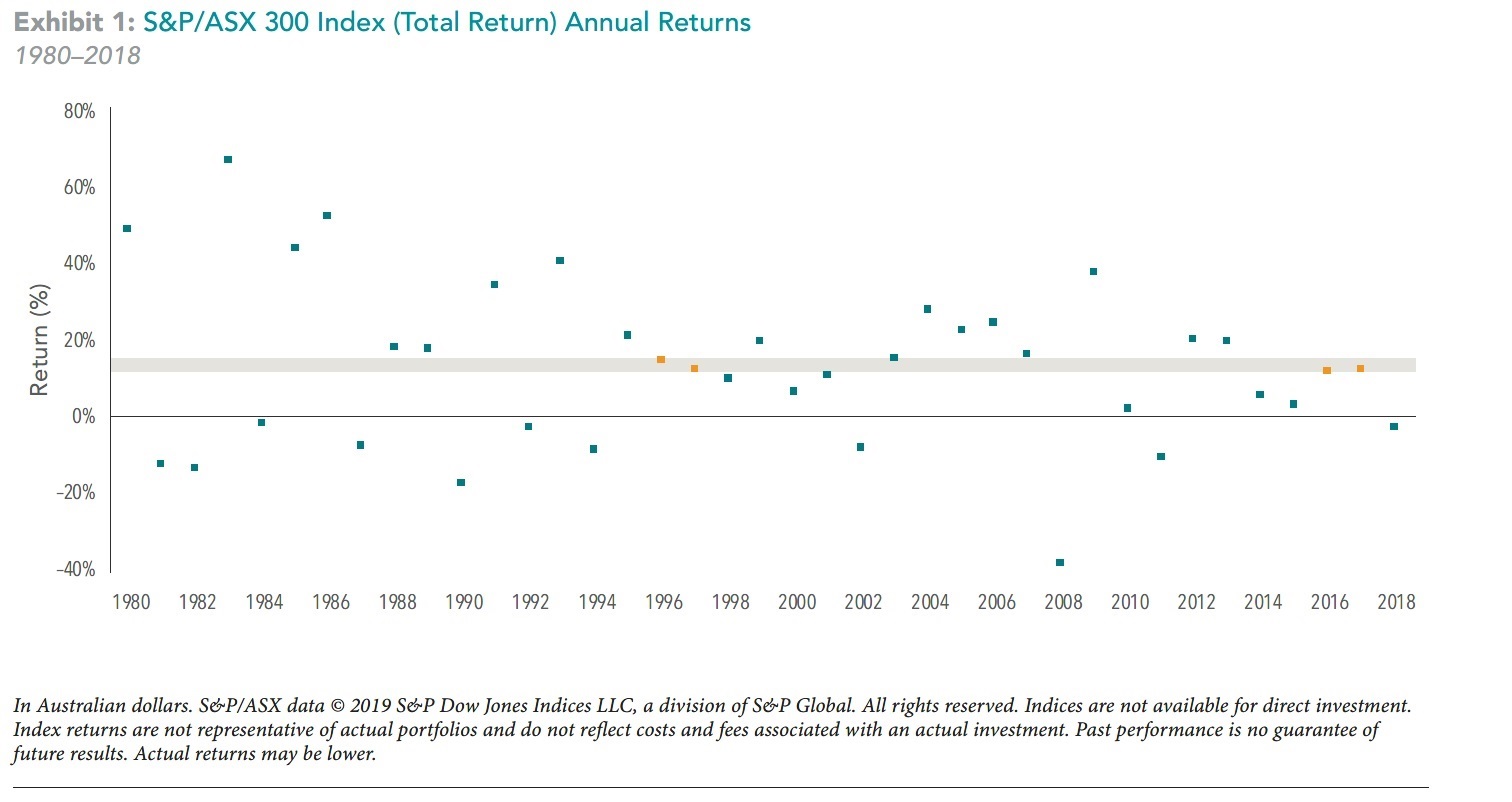
For instance, from 1980 to 2018 the Australian share market delivered an average annual return of nearly 13%. But in only four years over that near four–decade period have actual returns been within two percentage points either side of that average. In those 39 years, the local market has fallen in 11 calendar years and gained in 28 years, or more than 70% of the time in other words. The biggest one–year fall was during the global financial crisis of 2008, when the S&P/ASX 300 index fell nearly 40% on a total return basis. The biggest one–year gain was in 1983, when the market rose nearly 70%. Exhibit 1 shows that only in four years—1996, 1997, 2016 and 2017—has the local market’s annual movement been between two percentage points either side of the near four–decade average annualised return of 12.94%.

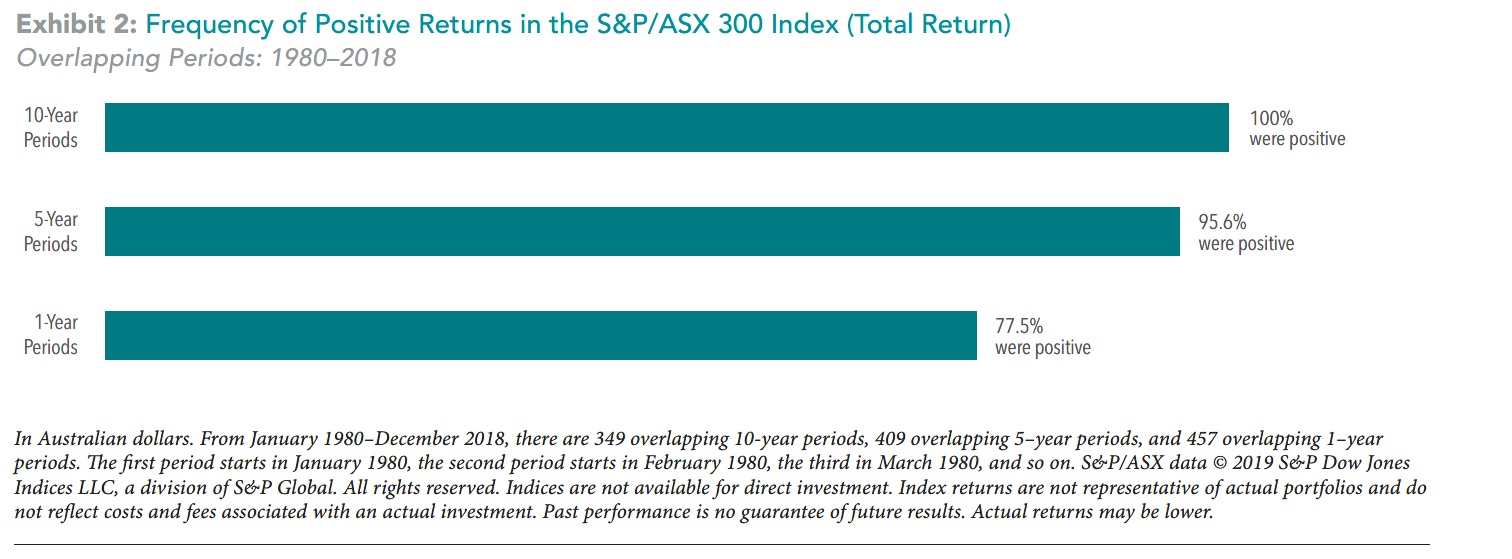
Dealing with volatility is part of the price investors payfor the returns on offer from equity markets. Those returns are unpredictable from year to year, making it near impossible to time the market. This means the only way of securing the long–term average returns on offer is staying in your seat. The benefits of a long–term focus can be seen in Exhibit 2. This shows you the historical frequency of positive returns from Australian shares over different rolling periods. This is a way of comparing returns for overlapping holding periods, starting from different dates. So, in this case, the first period starts in January 1980, the second in February 1980 and so on. In this case, we are projecting one year, five years and 10 years forward from each starting point.


The chart shows you that one–year returns on a rolling basis were positive 77.5% of the time in our sample period from 1980 to 2018. This increased to 95.6% over five–year periods and 100% over 10–year periods. (By the way, just because the 10–year rolling period performance in this relatively short sample has always been positive doesn’t mean it will always be so. In the US, for instance, where we have data going back to the 1920s, there have been longer periods when there was no market premium). What this all means is that just being aware of the range of potential outcomes in markets year to year can help you remain disciplined, which in the long term can increase the odds of having a successful investment experience.

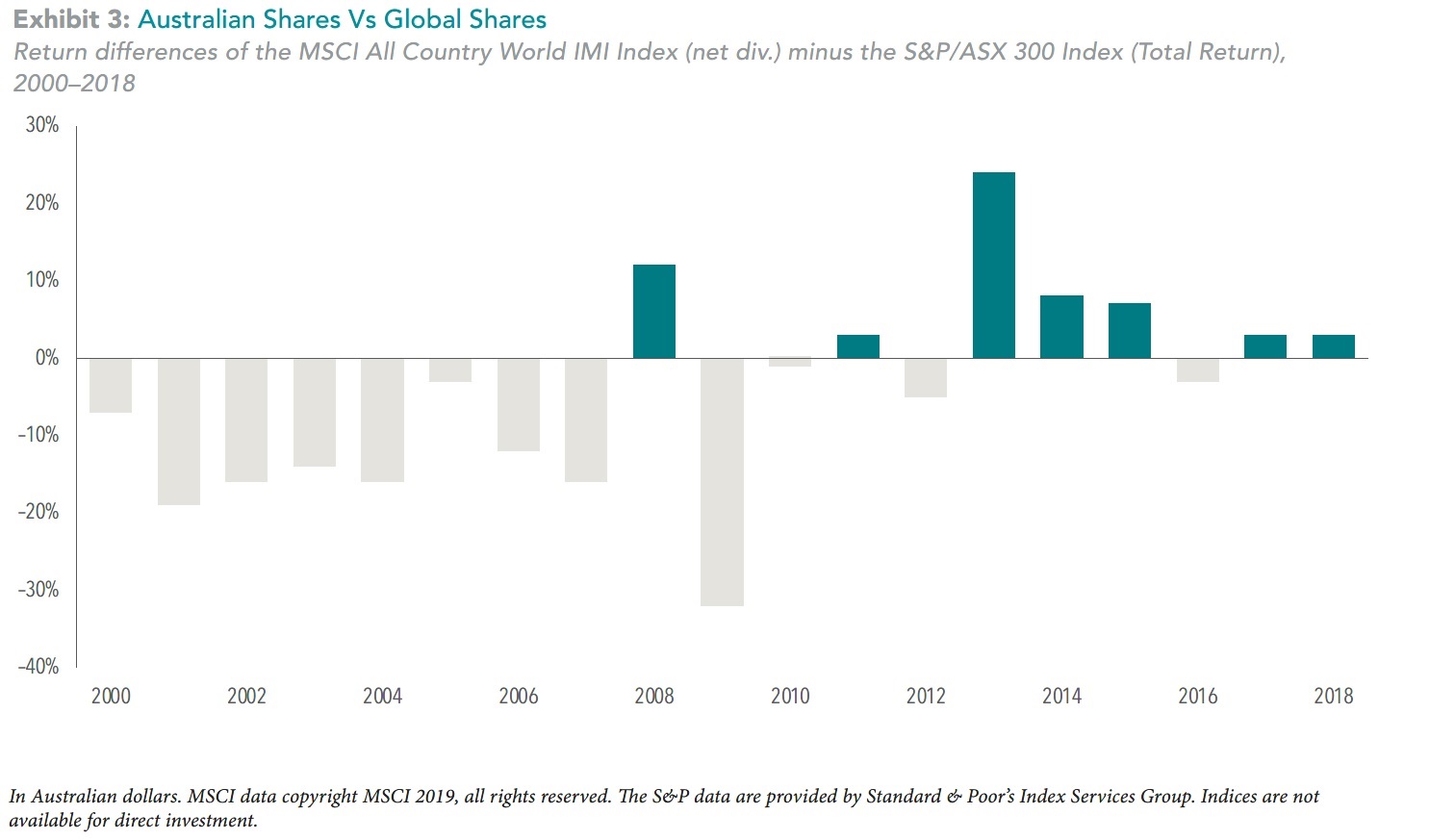
Aside from discipline, another way of dealing with volatility is diversification. Just as farmers deal with variable rainfall by planting different types of crops, investors can manage volatility by spreading their bets. Exhibit 3 compares the return of Australian shares over the rest of the world from 2000 to 2018. The result is the gap between the two. A negative number means Australia outperformed the rest of the world. A positive means the rest of the world beat Australia.

So, you can see that Australia did very well in the early years of the millennium, compared to other markets. You may recall this was the time of the China–led resource boom. More recently, Australia has lagged other markets. The point of this is to show that you can lessen your reliance on the year–to–year performance of the Australian market (which after all only makes up about
2% of the world market) by spreading your investments to include international markets. Diversification is a way of reducing the bumpiness of returns and of increasing the reliability of outcomes. This way you become less exposed to one market or one or two dominant sectors, which in Australia’s case currently are resources and banks.

In summary, the notion of “average” returns can be misleading. It’s wise to understand and be prepared for the range of individual outcomes that makes up that average. You can deal with the ups and downs in two ways. Firstly, by taking a long–term view and remaining disciplined, you are more likely to experience that average return. Secondly, you can diversify across countries so that you lessen the impact of big swings in any one market. Of course, this still doesn’t guarantee there won’t be investment droughts, but this may make it easier for you to stick with your plan and reap the harvest in the end. (See a shorter version of this article on our public website Perspectives blog here.)

This article has been prepared and is provided in Australia by DFA Australia Limited (AFS Licence No. 238093, ABN 46 065 937 671). The article is provided for informational purposes only. Any opinions expressed in this article reflect the authors judgment at the date of publication and are subject to change. No account has been taken of the objectives, financial situation, or needs of any particular person. Accordingly, to the extent this material constitutes general financial product advice, investors should, before acting on the advice, consider the appropriateness of the advice, having regard to the investor’s objectives, financial situation, and needs. This is not an offer or recommendation to buy or sell securities or other financial products, nor a solicitation for deposits or other business, whether directly or indirectly. ©2019 Dimensional Fund Advisors LP. All rights reserved.

Poll Position?

Jim Parker, Vice President, Dimensional Fund Advisors  May 2019

Australia’s recent federal election result not only confounded the pollsters, the pundits and the punters, it provided another lesson about the dangers of using political news headlines to guide your investment strategy. By just about every measure, the Australian Labor Party was seen as the overwhelming favourite to defeat the six-year-old Liberal-National Coalition government in the May 18 election by securing a majority in the 151-seat House of Representatives.

In the weeks leading up to the election, every major opinion polling company—from Newspoll to Ipsos to Galaxy to Essential to Morgan—had Labor ahead either at 52-48% or 51-49% on a two-party preferred basis. As well, the view of most media pundits was that Labor would almost certainly get across the line, with only the margin of victory in doubt. The bookmakers were also confident of the outcome, with the ALP at odds of as skinny as $1.16 in the days before the poll. Before polling day, one agency even paid out $1.3 million to gamblers who had backed Labor early in the process. As it turned out, the election outcome defied them all.

The Coalition secured a slight majority in the House of Representatives. Labor’s expectations of solid gains in Victoria were foiled, while the electorate swung heavily against it in Queensland and Tasmania in particular. The overall result was almost the exact opposite of what the pollsters predicted, with the Coalition ahead 51-49%. While others comb over the political implications, the lessons for investors are familiar.

News is quickly built into securities prices and unless you can predict what tomorrow’s news will be, you will struggle to do better than by just accepting market pricing and building a diversified portfolio around the long-term drivers of higher expected returns. For instance, in the months leading up to the election, some investors predicted that Labor’s announced policies on franking credit refunds, negative gearing and capital gains taxes would have a negative impact on banks and financial services companies, while its plan to cap annual health insurance premium increases might hurt listed health insurers.

When the election result confounded just about everyone’s expectations, the pricing of stocks in those sectors adjusted to reflect the outcome. The lesson is that markets are constantly changing their assessments about expected returns based on new information. Trying to second guess prices requires getting two things right—what will happen next and how the market will react to it.

Pundits were similarly wrongfooted in other votes in recent years. In 2016, ahead of Britain’s referendum on leaving the European Union, there were predictions of turmoil in global markets should the ‘leave’ camp win the vote1. To be sure, there was an adverse reaction initially to the unexpected victory by the Brexiteers. But this reaction was short-lived. By October of that year, the UK benchmark FTSE-100 index was near record highs, with analysts attributing the gains to the competitive advantages provided to British companies by the weaker pound2.

Likewise, ahead of the US presidential election that year, there were media predictions of a market decline if Donald Trump won. CNN ran with the headline that a Trump win would ‘sink stocks’3. The Atlantic said investors were terrified of a Trump victory. Yet in the two and a half years since his election, the S&P 500 has gained more than 35%, hitting repeated highs and reaching record levels by April this year. We should expect that markets will continually weigh the implications of political, economic and other news on expected returns. People can make predictions about political outcomes. But we have seen that this is a haphazard occupation. And even if you did anticipate what would happen, there is still no guarantee the market will move in the way you expect.

Geopolitics is only one of a myriad of influences on markets. And separating any one influence out is extremely difficult. By all means take an active interest in political news as a citizen. But as an investor, it’s a tough ask to build a strategy around it. That all suggests the best approach is to focus on your own investment goals, build a diversified portfolio aimed at getting you there and let markets deal with the news.

This article has been prepared and is provided in Australia by DFA Australia Limited (AFS Licence No. 238093, ABN 46 065 937 671). The article
is provided for informational purposes only. Any opinions expressed in this article reflect the authors judgment at the date of publication and are
subject to change. No account has been taken of the objectives, financial situation, or needs of any particular person. Accordingly, to the extent this
material constitutes general financial product advice, investors should, before acting on the advice, consider the appropriateness of the advice, having
regard to the investor’s objectives, financial situation, and needs. This is not an offer or recommendation to buy or sell securities or other financial
products, nor a solicitation for deposits or other business, whether directly or indirectly. ©2019 Dimensional Fund Advisors LP. All rights reserved.

1. Brexit Could Unravel the Global Markets, Fortune, June 20, 2016.
2. FTSE 100 Nears Record High as UK Exporters Take Advantage of Pound Collapse, The Independent, October 11, 2016.
3. ‘A Trump Win Would Sink Stocks’, CNN, Oct 24, 2016. ‘Why Investors are Terrified of a President Trump’, The Atlantic, October 24, 2016.

The Royal Commission – APC’s Response

As you would likely have heard the Royal Commission’s final report was recently released.

This article summarises the Commission’s findings as they relate to client focused issues in Financial Advice and considers what APC’s approach to each is.

Australian Private Capital (APC) has adopted practices for many years that reflect the intentions of the Royal Commission.  Broadly this is that Financial Advisers should act in the best interest of their client and that there should be preferably no conflict of interest and if there is a conflict it should be adequately managed.  Whilst many in the Financial Advice space are anxious about the future, APC has no such concerns.  

We believe as the Government implements the findings of the Commission and ‘vested interests’ vocalise their worries, it will only serve to highlight the benefits of choosing a firm such as APC.

Recommendation – Annual renewal and payment

Commission
This recommendation is primarily focused on the issue of clients paying fees for services they have not received.  The Commission recommends that fee arrangements aref renewed annually and services that the client should receive are clearly explained.

APC
As a client of APC you will have signed a Private Client Services Agreement which clearly outlined the services we will provide you.  We conduct our Regular Planning Meetings every six months where we clearly outline and re-confirm what your Private Client Service fee arrangement is and annually we provide a Financial Disclosure Statement which confirms the fee paid and the services delivered.

We also re-confirm your Private Client Fee arrangement whenever we provide new written advice to you.  So we have a focus on ensuring clarity around fees, charges and services provided.

Recommendation – Disclosure of lack of Independence 

Commission
A substantial theme of the Royal Commission is to better manage conflicts of interest.  This recommendation provides for specific written disclosure where an Adviser receives conflicted remuneration or where any conflict exists that may influence their recommendation.

APC
APC is not remunerated by commission payments and has no conflicts that influence our advice to our clients.

Recommendation – Grandfathered income

Commission
The Commission recommends the removal of all grandfathered income which under current legislation is allowed. Grandfathered income is trail commission paid to financial advisers from products that have been in place prior to 1 July 2013. The commission believes that this provision potentially locks clients into old higher fee paying products.

APC
APC introduced our Private Client Service Agreements many years ago and as a result we have very few clients who fall under this category which represents less than 1.5% of our business income.  However in July 2018, prior to the Royal Commission discussing this issue, we commenced a project to assist these clients to access the relevant advice they need.  We would expect that by June 30 this year this project will be complete with all grandfathered income removed.

Recommendation – Life Risk Insurance Commissions

Commission
The Commission broadly considers that exemptions to laws should be eliminated in general, but specifically in relation to conflicted remuneration. However, it recognises that the current Life Insurance Framework has only been in place since 1 January 2018 and that ASIC is due to review it after three years. The Commission believes ASIC should be allowed to complete its review in 2021 and that no further changes to life insurance be made until this occurs.

APC
APC is not remunerated by commission payments.  Our firm’s position on this issue has been ‘ahead of the curve’ for many years having identified this clear conflict.  Our view is simple….Commission payments have no place in professional advice.

Recommendation – Mortgage Broker Commissions

Commission
Broadly the Commission is of the view that banks paying mortgage brokers a commission to place debt products for their clients is a structural conflict of interest.  Its recommendation is the removal of such payments so that the obligation of payment rests with the client.  In this scenario the client can be 100% confident that the Mortgage Broker is representing their best interest as the bank no longer is paying the Mortgage Broker a commission.

APC
APC completely agrees with this approach.  Since we commenced offering debt facilitation services approximately 10 years ago we have adopted the approach that all commission payments received were to be returned to our clients 100%.   This serves to lower cost as well as to remove the conflict of interest which is the outcome the Commission is seeking to achieve.

However representatives of the Mortgage Broking industry are lobbying hard in Canberra and both the Government and the Opposition seem to be moving away from the Commission’s recommendation.   Irrespective of this outcome, clients of APC will continue to receive conflict free, lower cost debt implementation.

Recommendation – Reporting Compliance Concerns

Commission
All Australian Financial Services Licence (AFSL) holders should be required, as a condition of their licence, to report ‘serious compliance concerns’ about individual financial advisers to the Australian Securities and Investments Commission (ASIC) on a quarterly basis.  This recommendation seeks to formalise and improve existing breach reporting by AFSL holders to ASIC where there are serious compliance concerns about an adviser.

APC
Australian Private Capital has held an Australian Financial Services License (AFSL), since March 1989.  Over that time the firm has always held the view that ‘our license is our business’ and considered the compliant operation of our firm and the integrity of the advisers within our firm to be of paramount importance.  Very few small advisory firms have a Practice Manager however APC has had one since 2002. This is an indication of the seriousness with which compliance is held at APC. 

Recommendation – Remuneration of Front Line Staff 

Commission
The Commission devotes a significant part of its final report to discussing the role of remuneration in driving behaviour in financial services entities. This recommendation is aimed at ensuring remuneration structures do not incentivise misconduct. The report references examples of limiting the proportion of remuneration that is variable and linking it to genuine non-financial metrics.

APC
APC measures the performance of all staff using the well-established 360 Balanced Scorecard methodology.  It is used by many large companies but very few small ones.  No staff member of APC has any financial metric on their personal balanced scorecard.  Staff performance is measured by an assessment against their position description and client satisfaction measurements such as our client survey.  All our staff are salaried and are entitled to receive a Short Term and Long Term reward.

Summary

The Royal Commission was clearly required to shine needed light on some very poor behaviour.  However, it has served to validate that decisions APC has made over nearly 30 years of providing advisory services to our clients.

APC’s ‘Client First’ philosophy demands that our client’s best interest is at the forefront of all the advice we provide. 

Integrity and honesty are guiding principles that are reflected not only in our client relationships but also our co-worker relationships as well.

We have a sincere interest in helping our clients achieve better outcomes for them and their families and we understand trust is a required ingredient for developing long term relationships.

It is the reason why still today over 80% of our new clients are referred to us by existing clients.

If there is anything in this article that you would like to discuss we would encourage you to make contact with your APC Advice Team. We are happy to assist in any way.